
Burlington Parole and Probation Compared
Parole is release from a prison term into legal supervision. The New Jersey State Parole Board, or NJSPB, supervises state parole and certain mandatory-supervision terms. Probation is a sentence imposed by a court. New Jersey Judiciary Probation Services administers adult probation, and a person can receive it without serving a state prison term. A Burlington County jail release to probation should be supported by the sentencing or release order.
The distinction controls where to look. NJDOC history and State Parole Board records are the useful pair for parole. A Burlington Vicinage case disposition and Judiciary routing are the useful pair for probation. The county jail tracks the custody event, but it does not turn a release into parole merely because the person left its roster.
| Point | Parole | Probation |
|---|---|---|
| Legal basis | Release from imprisonment under supervision | Court-ordered sentence or supervision status |
| Primary agency | New Jersey State Parole Board | New Jersey Judiciary Probation Services |
| Best public starting record | NJDOC incarceration history and parole dates | Burlington Vicinage criminal case disposition |
| Does it prove state prison? | Usually tied to a state prison sentence | No, probation can follow a non-prison sentence |
Note: A release order may include supervision, but the order and supervising agency should confirm which kind applies.
Verify Burlington County Post-Release Supervision
No official statewide tool lets a user type a name and see every person now on parole. Public parole eligibility notices cover selected people nearing review, not the full supervised population. Verification therefore needs several records. Start with identity, custody system, and case number. An SBI number is especially useful because it separates people who share a name.
- Search the NJDOC Offender Search for a state custody history. Read the current facility, Date Out-of-Custody, and parole-related dates.
- Use the PROMIS/Gavel public search to match the Burlington County case and read the disposition or sentence.
- For possible parole, contact NJSPB with the SBI number and case facts. Public disclosure may be limited, so the released person should use assigned-officer paperwork.
- For possible probation, use the Burlington Vicinage contact route and provide the case number for Criminal Division or Probation Services routing.
- For formal proof of the custody change, request the release or movement entry from the agency that held the person.
The county’s full released-person search and records path is set out on the Burlington County released inmates home page. It helps distinguish community release from a transfer to NJDOC, another county, federal custody, or ICE.
Burlington County Parole District Office
Burlington County falls within NJSPB District Office 6. The office covers Burlington, Hunterdon, and Mercer counties. It is the documented regional parole contact, while probation questions belong to the Judiciary. Calling the parole office with a full name alone may not produce a public confirmation. Bring the SBI number, case number, and known NJDOC custody dates when the agency permits an inquiry.
New Jersey State Parole Board, District Office 6
210 South Broad Street, 4th Floor
P.O. Box 865
Trenton, NJ 08625
609-292-4383
The official NJSPB locations page shows the district office and its contact route.
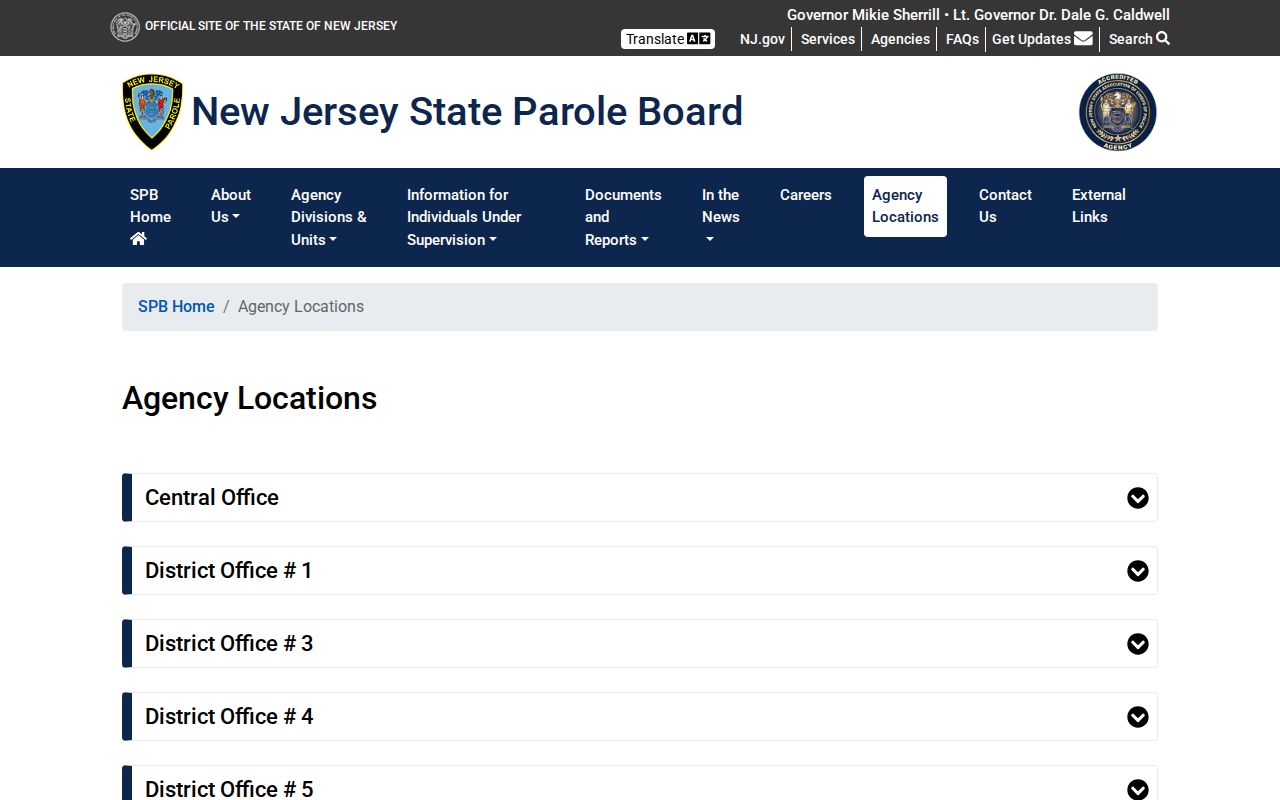
The captured office listing gives Burlington County readers a direct state source rather than a broad county directory entry.
Note: District Office 6 handles parole; Burlington Vicinage and Judiciary Probation Services handle probation matters tied to court cases.
Burlington Parole Hearings Are Not Release
A parole eligibility date begins a review process. It is not the date a person walks out. The Board describes an initial hearing by a hearing officer and, when appropriate, a two-member panel hearing. A panel may grant or deny parole. A denial can result in a Future Eligibility Term. Even after a grant, new information before physical release can lead to a rescission hearing.
The NJSPB hearing process explains the stages and possible results.
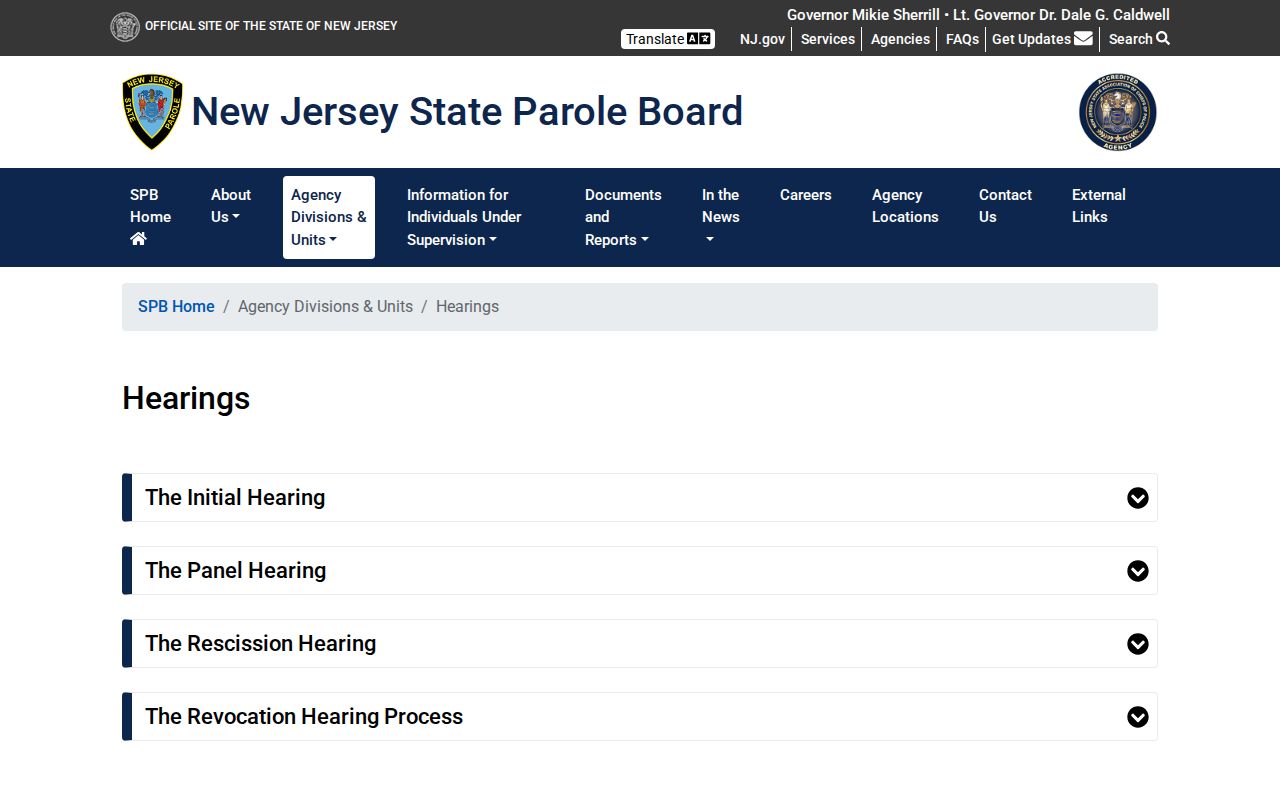
This sequence explains why the NJDOC Date Out-of-Custody is stronger proof of a completed custody event than a hearing date or grant alone.
Public notices can help place a named person in a review cycle, but they are not a live parole roster. The current parole eligibility notice is organized around scheduled eligibility activity.
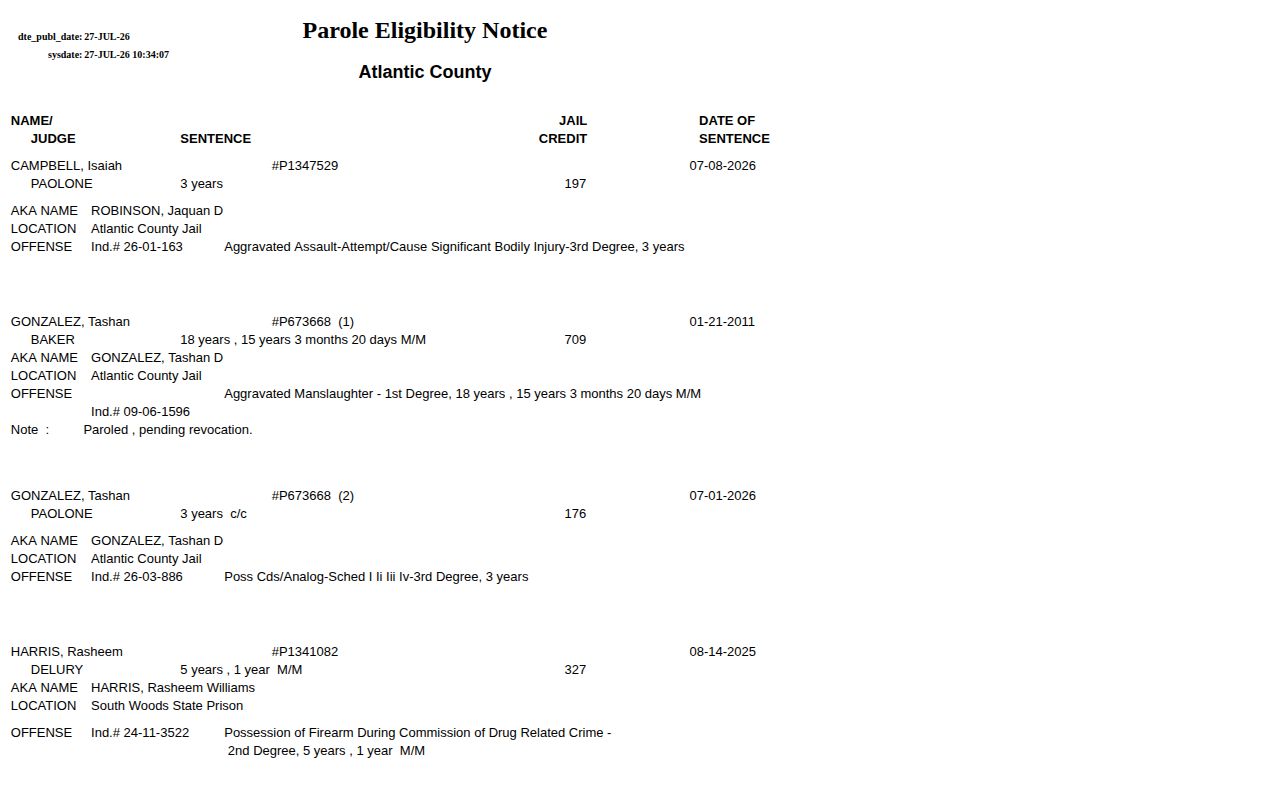
A notice should be read as evidence of a stage in the process, not proof of release or current Burlington County supervision.
Burlington Supervision Record Terms
Agency labels can look alike while describing different events. Define the term before drawing a conclusion from a date or status. That is vital when NJDOC, a court docket, and a parole record describe the same case from separate viewpoints.
- Parole
- Release from imprisonment into supervision before full sentence discharge.
- Probation
- A court sentence supervised by Judiciary Probation Services, not proof of state imprisonment.
- Discharge
- The formal end of the custody or supervision term identified by the issuing agency.
- Absconder
- A person alleged to have stopped complying or whose location is unknown to supervision.
- Revocation
- A Board action that can return a parolee to custody after the required violation process.
The State Parole Board’s notices and publications hub is the official route to published Board material.
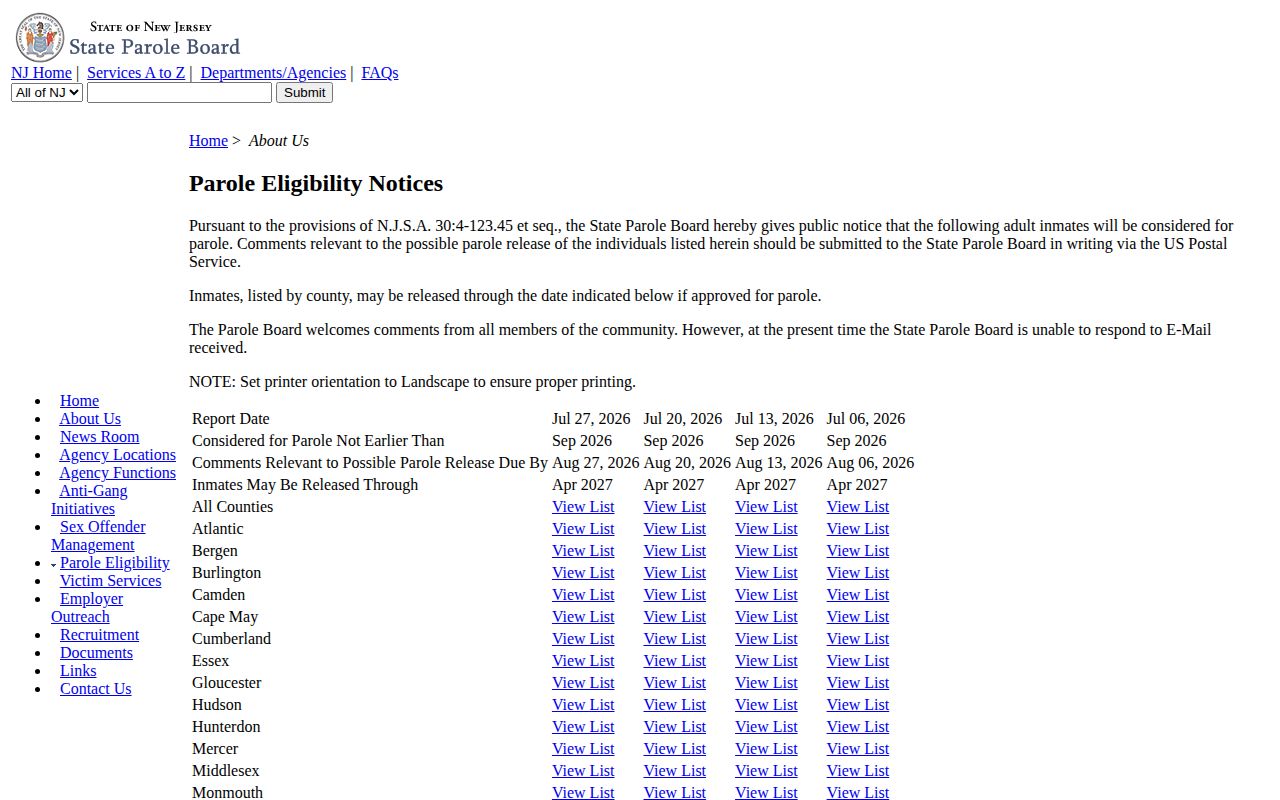
The hub separates public notices from individual supervision records and makes that limit easier to see.
Burlington Parole Warrants and Absconders
An absconder label is not the same as a normal release. A parole warrant can return a person to custody, and serious or persistent alleged violations can lead to probable-cause and revocation proceedings. The possible result may be revocation with a new future eligibility term or continued parole with conditions.
Burlington County’s directory identifies the Sheriff’s Warrant Unit at 609-265-5504. The Sheriff app also advertises wanted-fugitive information. Neither is a complete public list of people on parole, and no official public Burlington County parole-absconder database was found. A wanted listing therefore cannot confirm a former inmate’s release date, supervision status, or full warrant picture. The parole agency and issuing court remain the right authorities.
Burlington Supervision Notification Channels
New Jersey VINE and State Parole Board victim registration serve different roles. VINE can report a participating agency’s custody change by phone, text, email, or app. It may distinguish release from transfer, but it does not act as a complete public supervision list. A VINE result should be matched to the holding agency and confirmed with that agency when a formal record is needed.
The NJSPB Victim Services registration is a separate direct channel for parole proceedings. The unit lists 609-376-0269 and accepts its form through the official email or fax routes shown by the Board. This process should not be confused with a name search. Likewise, the New Jersey Sex Offender Internet Registry covers only people who meet statutory publication rules. It is not a full Burlington County parole, probation, or released-inmate list.
Burlington Release Treatment Bridge
The Burlington County Court Liaison Program creates a local bridge among custody, courts, and treatment. County material says it conducts weekly evaluations at the Detention Center and Minimum Security Facility and makes treatment recommendations for people referred by the court.
That placement has to be described with care. Movement from a jail to a program may occur under a court order or another form of control. It is not automatically an unconditional release, parole, or probation. The court order and the receiving program determine the legal status. When a case record mentions treatment, compare it with the release entry and the court disposition before deciding what happened.
Note: A treatment recommendation is not itself a release order, and a program placement may retain court-imposed limits or reporting duties.
Burlington State Release Documents
People leaving New Jersey state prison receive a practical set of records under NJDOC’s Fair Release and Reentry work. The Office of Programming and Supportive Services says the portfolio can include final discharge paperwork, a temporary release photo ID, identity documents when available, trust-account material, and notice of active warrants or detainers where applicable.
These documents help the released person verify identity, custody departure, money held in trust, and any next legal step. Most are not public name-search fields. Family members or other requesters should not expect the NJDOC search to reproduce the personal portfolio. For supervision, the reporting paperwork and assigned officer are more direct than a public search. For a disputed release date, the Date Out-of-Custody and final discharge papers should be compared.
How Burlington Supervision Ends
Release from a jail or prison and discharge from supervision are separate events. Parole can continue after NJDOC shows a Date Out-of-Custody. Probation can continue after a county jail term ends. The agency with authority over the supervision must record its formal end.
For parole, use the State Parole Board and the person’s reporting or discharge papers. For probation, use the Burlington Vicinage case and Probation Services route. If public detail is limited, ask for the specific disposition or order that can lawfully be released rather than a broad personal file. A VINE alert may report a custody change, but it does not certify the end of parole or probation. The court and supervising agency provide the final legal record.